Octopus: Complete Deep Guide – Alien Intelligence, Camouflage Science, Problem Solving & Ocean Survival
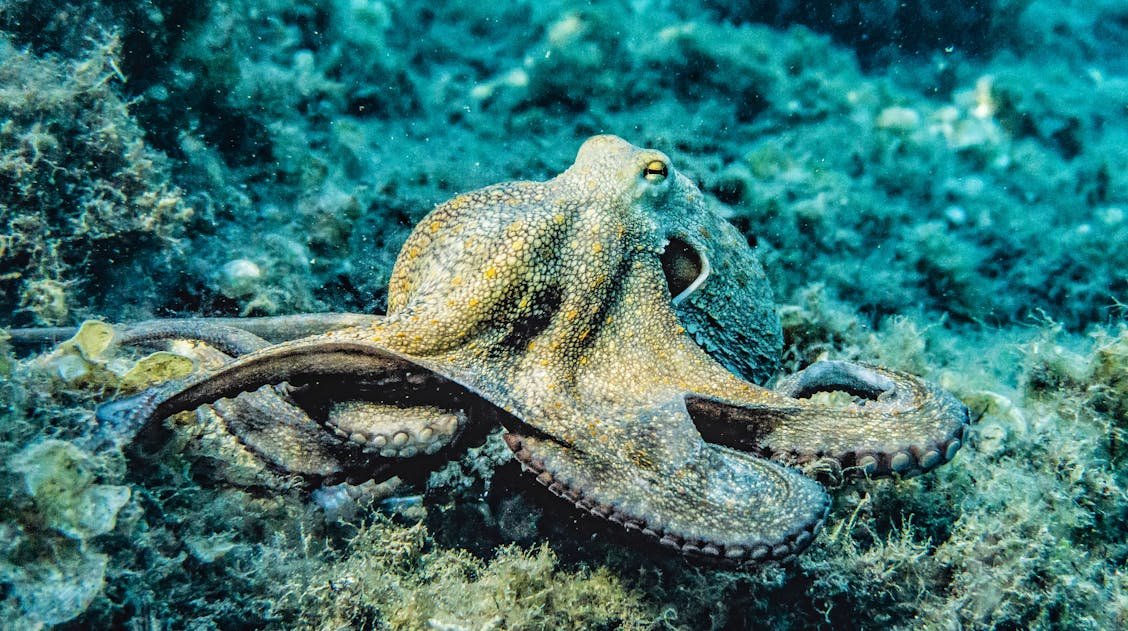
The octopus is one of the most intelligent and biologically extraordinary creatures in the animal kingdom because it combines advanced problem-solving abilities, shape-shifting camouflage systems, flexible body engineering, and highly developed nervous structures into a single marine organism, and unlike most animals that rely mainly on speed or strength for survival, octopuses depend on intelligence, adaptability, and environmental manipulation, making them appear almost “alien” compared to other life forms on Earth and turning them into major subjects of scientific research in neuroscience, robotics, camouflage technology, and animal cognition.
🌿 Biological Structure and Anatomy of the Octopus
Octopuses belong to the class Cephalopoda, and their anatomy is radically different from most vertebrates because they possess soft boneless bodies, eight muscular arms lined with suction cups, large highly developed eyes, and a decentralized nervous system where a significant portion of neurons are distributed throughout the arms instead of being concentrated only in the brain, allowing each arm to process information and perform independent movements with remarkable precision and coordination.
🧠 Intelligence and Problem-Solving Abilities
Octopuses are considered among the most intelligent invertebrates because they can solve puzzles, open containers, navigate mazes, recognize patterns, and learn through observation and experience, and laboratory studies have shown that octopuses can remember solutions to problems, use tools such as coconut shells for shelter, and adapt behavior based on changing situations, demonstrating cognitive flexibility rarely seen outside mammals and birds, while their intelligence is especially remarkable because it evolved independently from vertebrate intelligence, making octopuses an important example of convergent evolution in cognition.
🎨 Camouflage and Shape-Shifting Science
One of the most extraordinary abilities of octopuses is their advanced camouflage system, where specialized skin cells called chromatophores, iridophores, and leucophores allow rapid changes in color, brightness, and texture, enabling the octopus to blend perfectly into rocks, coral, sand, or seaweed within seconds, while muscles beneath the skin can also create bumps and ridges that mimic surrounding surfaces, making octopus camouflage one of the most advanced biological concealment systems ever discovered in nature.
🦑 Flexible Body Engineering and Escape Abilities
The octopus has no rigid skeleton except for its beak, which means its body can squeeze through incredibly small openings as long as the beak fits through, allowing escape from predators and confined spaces with astonishing efficiency, while this flexibility also enables highly dynamic movement patterns including crawling, swimming, and jet propulsion, making octopuses masters of physical adaptability in underwater environments.
☁️ Ink Defense and Survival Strategies
When threatened, many octopus species release dark ink clouds composed mainly of melanin and mucus, which confuse predators by blocking vision and disrupting smell-based tracking systems, while the octopus escapes using rapid jet propulsion generated by expelling water through a muscular siphon, and this combination of camouflage, intelligence, flexibility, and chemical defense creates one of the most effective survival systems among marine animals.
🌍 Ecological Importance of Octopuses
Octopuses are important marine predators that help regulate populations of crustaceans, mollusks, and small fish within ocean ecosystems, while they also serve as prey for sharks, dolphins, seals, and larger fish, making them important components of marine food webs and ecological balance, especially in coral reef and deep-sea environments.
🧬 Evolutionary Uniqueness of Octopuses
Octopuses are evolutionarily unique because their intelligence, nervous system complexity, and adaptive behaviors developed independently from vertebrate animals, and scientists often describe them as examples of “alternative intelligence” because they demonstrate advanced cognition through completely different biological pathways than mammals, making them valuable organisms for studying the evolution of intelligence itself.
🤖 Scientific and Technological Inspiration from Octopuses
Octopus biology inspires major research in robotics, materials science, and artificial intelligence because scientists study octopus arms to develop flexible robotic systems capable of delicate movement in difficult environments, while camouflage research influences military concealment technologies and adaptive materials engineering, proving that octopus biology continues to shape future scientific innovation.
🧠 Psychological Fascination and Cultural Symbolism
Humans are deeply fascinated by octopuses because they combine intelligence, mystery, adaptability, and alien-like appearance into a single creature, and throughout mythology and modern media octopuses are often portrayed as symbols of intelligence, unpredictability, depth, and hidden power, while their ability to transform and escape creates strong psychological associations with creativity and survival under pressure.
🐙 Conclusion
The octopus is far more than a sea creature because it represents one of the most advanced combinations of intelligence, biological engineering, camouflage, and adaptability found in nature, combining decentralized cognition, flexible anatomy, and problem-solving abilities into a life form so unique that it continues to challenge human understanding of intelligence and evolution, making the octopus one of the most scientifically fascinating organisms on Earth.
❓ FAQ
1. Why are octopuses considered intelligent?
Because they solve problems, use tools, and learn from experience.
2. How do octopuses change color?
Through specialized skin cells called chromatophores and iridophores.
3. Can octopuses escape small spaces?
Yes, their soft bodies allow them to squeeze through tiny openings.
4. Why do octopuses release ink?
To confuse predators and escape danger.
5. What makes octopuses unique evolutionarily?
Their intelligence evolved independently from vertebrate animals.







Post Comment